
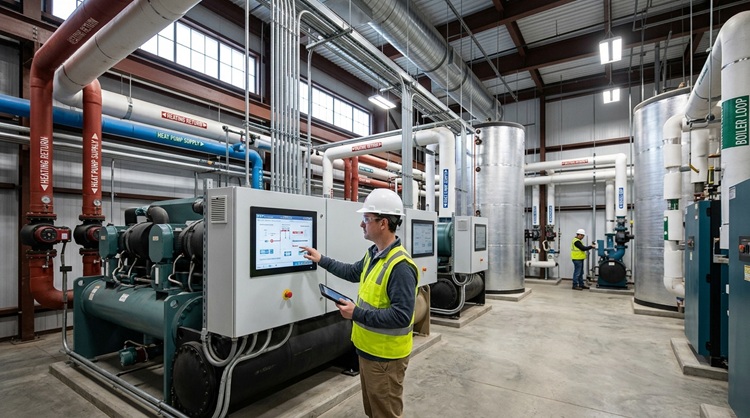

A boiler heat pump system doesn’t always require a facility to remove its existing boiler. In a hybrid arrangement, a heat pump covers much of the routine heating load while the boiler supports peak demand through the building’s existing hydronic circuits or hot-water plant. With suitable sizing and controls, operators may be able to reduce gas use without replacing the entire heating system.
Table of Contents
What you actually get with a hybrid setup
A boiler heat pump system is often called a hybrid or bivalent system. The names sound technical, but the idea is plain.
A facility can retain its existing boiler and add an air-source heat pump to work alongside it. Depending on the design, both may serve hydronic heating circuits, preheat hot water or support other building hot-water loads.
For much of the heating season, the heat pump can handle suitable base loads. It pulls warmth from outside air and moves it into the heating water using electricity, even when conditions feel cold. The boiler remains available for higher-temperature or peak demand.
The boiler steps in when demand outruns what the heat pump can do efficiently. That may happen on very cold nights, when hot-water demand spikes or during a fast warm-up after an overnight setback. The controls manage the handover, so building operators don’t have to flip a switch.
There’s an extra benefit that first-timers often miss. Some air-source heat pumps can operate in reverse cycle for summer cooling. A boiler cannot cool, and cooling is not automatic in a hybrid installation. Where the facility has suitable fan coils or chilled-water distribution, the heat pump may support cooling as well, subject to the system design.
This hybrid path can appeal to facility managers who want to keep useful boilers, pipework and heat emitters in service rather than replace the entire plant. Retaining sound infrastructure can limit disruption, while upgrades target the parts that cannot operate effectively at lower flow temperatures.
Why the efficiency numbers split in cold weather
Gas boilers and heat pumps don’t make heat in the same way. A good gas boiler turns about 85 to 95% of its fuel into usable heat. The rest leaves through flue gases and standby losses.
A heat pump moves heat rather than producing it by burning fuel. Its efficiency is shown as coefficient of performance, or COP. A COP of 4 means four units of heat for each unit of electricity. Heat pumps are 3-5 times more energy efficient than gas boilers (International Energy Agency).
That gap is real, although it changes with the weather.
COP falls as the outdoor temperature drops and the required water temperature rises. A mild autumn day with a low flow temperature might give a COP near 4 or above. A frosty night needing hotter water for heating circuits could pull that COP closer to 2. The unit still heats, but uses more power for each unit of heat.
Cold snaps therefore matter to system design in Canberra. Winter nights can sit well below zero while days rebound. A system sized only for mild conditions will lean on the boiler more than planned. One designed around a building’s winter demand can cover suitable base loads with the heat pump and reserve the boiler for peaks.
The short version is to think in seasons, not brochures.
Good design considers the building’s demand and heating circuits across Canberra’s winter, rather than relying on one mild-weather rating point.
How the system picks boiler or heat pump
The handover point has a name. Most installers call it the switch-over temperature.
It’s the outdoor temperature below which the controls favour the boiler and above which they favour the heat pump. No fixed number suits every building. One site might switch near zero, while another could hold the heat pump down to minus five before the boiler takes more load.
Four things move that set point. The electricity-to-gas price ratio matters because lower-cost power favours longer heat pump runs, while high electricity tariffs can tilt some demand towards gas. Capacity matters because an undersized heat pump reaches its limit sooner on a cold night. Emitter and coil sizing also count: some circuits need hotter water that better suits a boiler. Operating needs differ too; offices may have variable weekday loads, while facilities with continuous heating or hot-water demand need steadier output.
Weather-compensated controls bring these factors together. They read the outdoor sensor and adjust flow temperature instead of firing at one fixed setting all winter. On a cool but not cold day, the system might send 45-degree water to the loop. On a frosty morning, it might lift towards 55 degrees or hand part of the load to the boiler.
Building operators shouldn’t need to watch every handover. Correctly commissioned controls should help keep occupied zones at stable temperatures.
The control curve may need small adjustments over the first heating season as actual building demand becomes clear.
Patience pays.
What good installation looks like on the day
Good equipment paired with a sloppy installation still produces uneven temperatures, unreliable hot water and high bills. Hybrid projects succeed or fail at the installation stage.
Start with sizing. A proper job includes a zone-by-zone heat-load assessment covering floor area, glazing, insulation, air leakage and operating hours, plus hot-water demand where relevant. Oversizing is common when this step is skipped. An oversized heat pump can short-cycle, wearing parts and reducing the savings it was meant to deliver.
Pipework needs attention as well. The crew should flush the old hydronic loop, check water quality, dose inhibitor and confirm sealed-system pressure and expansion allowance before tying in the new unit. Old sludge damages new pumps and valves. Low expansion capacity makes relief valves drip whenever the loop heats.
Outdoor unit placement matters more than many facility managers expect. The air-source unit needs clear airflow, drainage for defrost water, suitable separation from noise-sensitive occupied areas and proper service access. Refrigerant runs should be short and neat. Electrical work requires appropriate certification, breaker sizing and isolation.
In the ACT, hydronic and gas work should be assigned to appropriately licensed tradespeople with relevant experience. Air-conditioning installation experience alone does not establish competence in boiler integration: sealed water circuits, gas isolation, controls and pump logic need specialist commissioning. For facilities comparing Boiler Heat Pump Services Canberra, the priority should be a contractor able to assess existing plant and coordinate the heat pump, boiler and controls as one system.
When comparing providers, ask who sets the control curve and returns to fine-tune it. Commissioning is more than a five-minute handover. It covers purging and balancing, flow-temperature limits, defrost settings and an explanation of normal operation for the building’s maintenance team.
Can your existing heating circuits run cooler?
Older boiler systems often operate at 70 to 80-degree flow temperatures, particularly where heating circuits and emitters were designed around high-temperature water.
Heat pumps usually perform better at lower flow temperatures, often around 45 to 55 degrees where the equipment and load permit. Existing radiators, fan coils and heating coils must still deliver enough heat at those temperatures; otherwise, upgrades or different operating settings may be necessary.
Check what you have before you promise savings
Survey the facility’s heating zones rather than assuming every circuit can operate cooler. Record radiator and coil sizes, valve types, flow rates and pipe arrangements, and check whether the plant also serves hot-water demands. Underfloor loops may suit lower temperatures, but some other circuits need modification. An honest survey is better than promising savings the distribution system cannot deliver.
Many facilities can prioritise a few critical upgrades rather than replace every emitter at once. Larger coils or suitable radiators may provide enough heat at lower flow temperatures, while the boiler covers cold-weather peaks or higher-temperature services. The right mix depends on the building’s operating profile and maintenance constraints.
Zones that regularly miss their temperature setpoints are a useful warning. Investigate emitter capacity and water flow before expecting the heat pump to solve the problem.
Why a buffer tank is sometimes added
A buffer tank is an insulated vessel that holds extra heated water. It allows the heat pump to run in longer, calmer cycles instead of switching on and off as zones open and close through cold mornings and mild afternoons. Short bursts wear parts and reduce seasonal COP because each start uses energy.
The tank can also support the heating circuit during defrost. The outdoor coil occasionally ices up in damp, cold weather, so the unit briefly reverses to melt it. Stored warmth can reduce disruption to heating while that happens.
Sealed-system pressure also needs monitoring. Gauges should remain reasonably steady through heating and cooling cycles. Wide swings can point to insufficient expansion allowance. Catching the issue early is easier than dealing with repeated plant faults.
What it costs and where first-timers slip
Commercial costs vary widely with plant capacity, hot-water demand, pipework, controls and the need to keep the building operating during installation. The useful comparison is the whole project, not just the heat pump price.
A hybrid retrofit may require a quality air-source unit, a buffer vessel where needed, controls, hydraulic alterations, electrical work and boiler integration. Those costs should include flushing, testing and commissioning. Quotes that leave out load calculations or plant integration can make a project look cheaper than it really is.
Running savings come from shifting suitable heating or hot-water loads from gas to electricity while the heat pump operates efficiently. The result depends on seasonal COP, electricity and gas tariffs, flow temperatures and hours of use. Facility managers should compare modelled annual energy consumption and operating costs before relying on any projected payback period.
Finance changes that calculation. Facility owners can investigate grants, energy-efficiency incentives or finance products that apply to their type of organisation and installation. Eligibility varies, so no rebate or subsidy should be included in the business case until the current rules have been checked.
Policy direction matters too. The ACT’s move towards electrification gives facilities another reason to review their long-term plant strategy. A hybrid can reduce reliance on gas now while leaving scope for further electrification when the building and budget allow.
Five mistakes to avoid
- Oversize the heat pump for peace of mind. It short-cycles from autumn through spring and never reaches a steady COP.
- Leave undersized radiators or heating coils unchanged and hope lower flow temperatures will cope. Cold zones can bring the boiler on early and erode savings.
- Set the switch point too high because of fear of the cold. The boiler then does work the heat pump could have done cheaply.
- Skip the heat-load assessment and size from the old boiler nameplate. Existing boilers may have been oversized or designed for a different demand profile.
- Hire separate trades without a hybrid lead. Hydronic water, refrigerant, boiler logic and controls need one person in charge.
Pay more for design once. It costs less than paying for fixes twice.
Start with the building rather than the brochure. Assess its heating loads and existing plant, then choose a switch-over strategy that suits occupancy and service requirements. A hybrid won’t make winter heating free, but a well-designed system can reduce gas demand while maintaining dependable heating and hot water. It also leaves scope to go further electric later.